
Bookshelf vs Floorstanding Speakers: High-End Comparison
Bookshelf vs floorstanding speakers: the B&W 603 S3 and Monitor Audio Platinum 100 3G are tested with the same amplifier across four revealing tracks.

Bookshelf vs floorstanding speakers: which design better suits your room, amplifier and music? To answer that question, this high-end audio comparison puts the Monitor Audio Platinum 100 3G and Bowers & Wilkins 603 S3 in the same medium-sized room, on the same amplifier and through the same four tracks.
Short answer: the B&W 603 S3 was the clearer, more spacious and more convincing all-rounder in this medium-sized room. The Monitor Audio Platinum 100 3G brought fuller upper-bass and lower-midrange energy at the initial listening level, which made dense electronic music and hard rock feel more immediate. One uses cabinet volume and more dedicated drivers; the other concentrates premium engineering into a compact two-way enclosure.
Bookshelf vs floorstanding speakers: key takeaways
- Choose the 603 S3 for scale and separation. It created the wider soundstage, clearer vocals and more stable acoustic image.
- Choose the Platinum 100 3G for density and immediacy. Its upper-bass and lower-midrange balance better suited dense electronic music and hard rock in this test.
- Room size does not decide the result by itself. Placement, toe-in, listening distance and room modes can change the bass and treble balance of either design.
- A bookshelf speaker may still need stands and a subwoofer. Those additions can improve placement and low-frequency scale, but they also change the complete system.
- Amplifier matching matters. Sensitivity and impedance differ, so the same volume-control position does not guarantee the same acoustic loudness.
A practical equal playing field
One important limitation: the same volume-control position is not the same as exact SPL matching. The 603 S3 is rated at 90 dB sensitivity and the Platinum 100 3G at 85 dB, so they may not produce identical acoustic loudness from the same amplifier voltage. The setup keeps the real-world variables consistent, but it should be described as a controlled listening comparison rather than a laboratory test.
Bookshelf vs floorstanding speakers: key design differences
These are not simply small and large versions of the same speaker. The Platinum 100 3G is a two-way standmount: one 6-inch RDT III cone handles bass and midrange before handing over to an MPD III high-frequency transducer. The 603 S3 is a three-way floorstander: two 6.5-inch cones handle the bass while a separate 6-inch Continuum cone handles the midrange. The tables below place their manufacturer specifications in the same order.
Two speakers, two separate specification tables
Read down either table to understand one speaker, or compare matching rows across the two cards.
Monitor Audio Platinum 100 3G
| Speaker type | Two-way, rear-ported standmount |
|---|---|
| Driver layout | 1 × 152 mm RDT III bass/mid 1 × MPD III high-frequency transducer |
| Published frequency figure | 37 Hz–60 kHz free-field 28 Hz–60 kHz in-room; both at −6 dB |
| Sensitivity | 85 dB (2.83 V at 1 m) |
| Nominal impedance | 4 ohms 4-ohm minimum at 180 Hz |
| Recommended amplifier | 75–300 W into 4 ohms |
| Cabinet size (H × W × D) | 398 × 225 × 325.6 mm |
| Weight | 15.2 kg each |
Bowers & Wilkins 603 S3
| Speaker type | Three-way, rear-ported floorstander |
|---|---|
| Driver layout | 2 × 165 mm paper bass 1 × 150 mm Continuum midrange 1 × 25 mm titanium-dome tweeter |
| Published frequency figure | 46 Hz–28 kHz ±3 dB 29 Hz–33 kHz at −6 dB |
| Sensitivity | 90 dB (2.83 V at 1 m) |
| Nominal impedance | 8 ohms 3-ohm minimum |
| Recommended amplifier | 30–200 W into 8 ohms |
| Cabinet size (H × W × D) | 985 × 190 × 340 mm 1020 × 260 × 402 mm with plinth |
| Weight | 27.5 kg each |
- The Platinum 100 3G concentrates the work. Its flagship standmount cabinet combines an RDT III cone with an MPD III high-frequency transducer. One cone handles both bass and midrange, and suitable stands are part of a complete installation.
- The 603 S3 divides the work. Its larger cabinet, twin bass drivers and dedicated midrange are designed to produce greater scale and headroom without requiring separate speaker stands.
- Extension is not the same as output. Monitor Audio specifies a lower −6 dB in-room figure, but one 6-inch driver cannot automatically match the displacement and headroom of two 6.5-inch bass drivers. Room placement and listening level determine how much of either claim you hear.
Technical sources: Monitor Audio Platinum 100 3G specifications and Bowers & Wilkins 603 S3 information sheet.
Published lab graphs: why the listening test makes sense
These measurements are for the same 3G and S3 generations used in this comparison. They help explain the listening notes, but they were produced by different publications in different rooms and should be read individually—not overlaid as though they came from the same test bench.
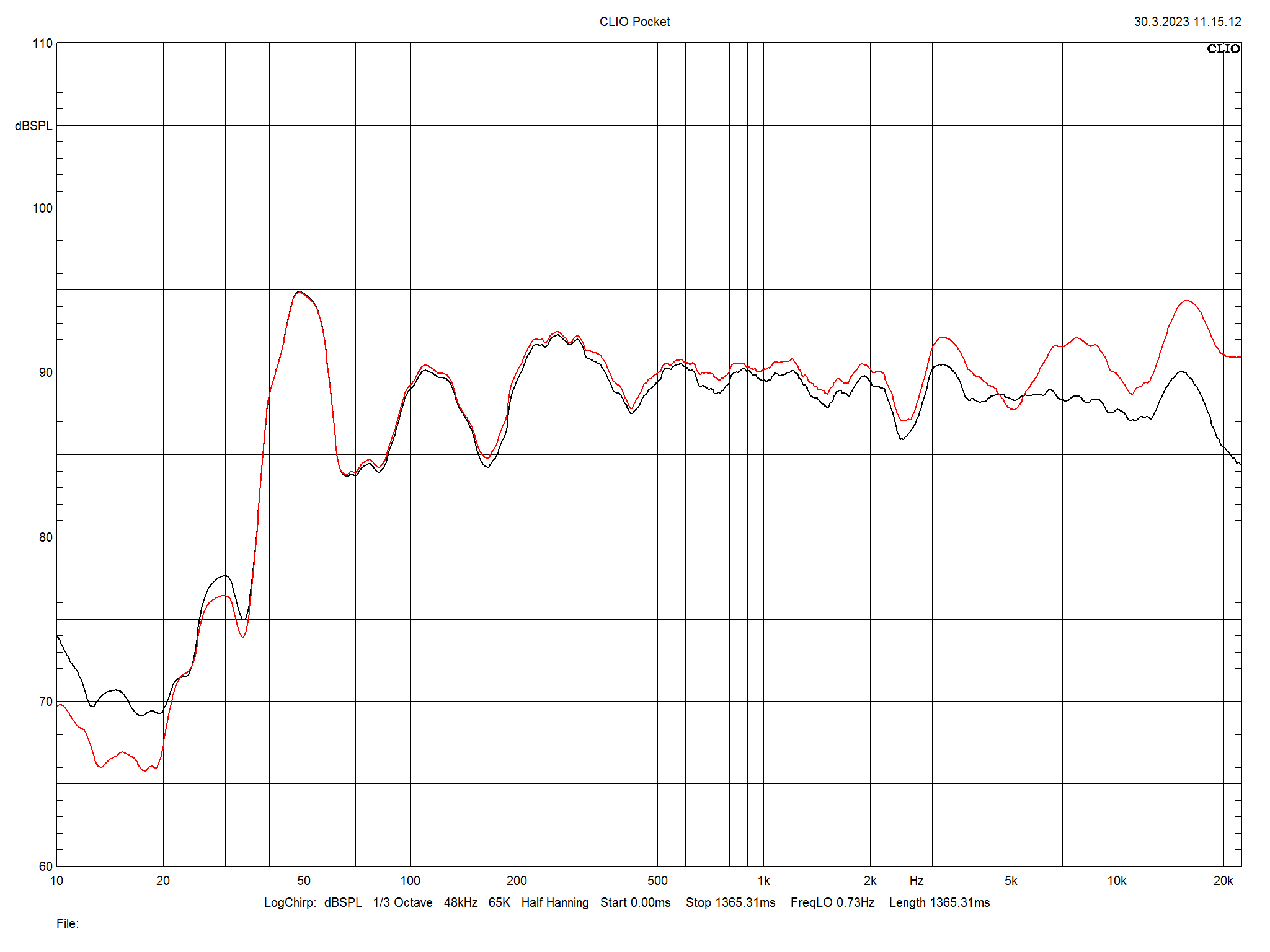
What the Platinum 100 3G graph explains
The thick, face-to-face balance has visible context. The in-room curve carries solid energy through the bass and lower midrange, which fits the density heard on “Destinations” and “Take the Power Back”. The response is not simply bass-heavy, however; the review also describes only a slight bass emphasis.
Toe-in can change how exposed the highs feel. The treble peak on the red on-axis trace is reduced on the black 30-degree trace. If the speakers were aimed less directly at the listening seat, that change in high-frequency balance could contribute to vocals and cymbals feeling less prominent inside dense mixes.
Deep extension does not guarantee floorstander scale. Monitor Audio specifies 37 Hz free-field and 28 Hz in-room at −6 dB. That describes extension, not maximum clean output. A single 6-inch driver can reach low while still moving less air than the 603 S3’s twin bass drivers when the music becomes demanding.
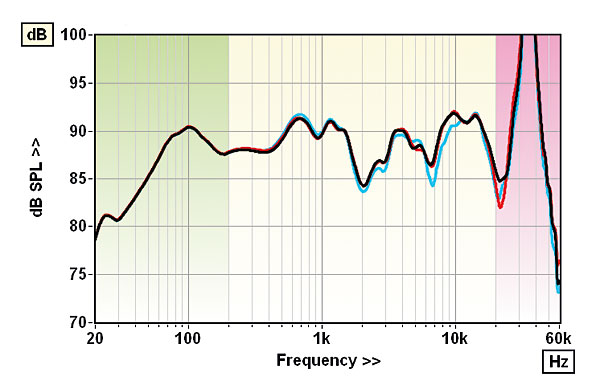
What the 603 S3 graph explains
The stable jazz image has measurable support. Hi-Fi News measured exceptional 0.45 dB pair matching from 200 Hz to 20 kHz. Closely matched left and right speakers help a piano, saxophone or snare remain fixed in the stereo image, supporting what “Take Five” revealed.
The 603 S3 has bass reach and headroom, not automatic bass emphasis. The lab measured 40 Hz extension at −6 dB, with the port tuned around 22 Hz. Twin bass drivers and the larger cabinet provide output potential, but listening level and room position still decide whether the kick feels lean or full at the seat.
The easy sensitivity number hides a demanding load. Hi-Fi News measured 88.7 dB average sensitivity, but also a 2.85-ohm impedance minimum and a very low EPDR. The 603 S3 can play loudly from modest voltage while still asking the amplifier for substantial current in parts of the bass.
The graphs explain tendencies, not the winner. They support the Platinum 100 3G’s dense low-mid character and placement-dependent treble, plus the 603 S3’s image stability, bass headroom and electrical demands. They cannot decide which presentation better suits your music.

Rival Consoles — “Recovery”
Monitor Audio Platinum 100 3G
The Platinum 100 3G put the midrange forward with confidence. Its presentation was bold and close, and the kick transients were especially easy to follow: I could hear the skin being struck even when I did not feel as much air moving around the room. The trade-off was scale. With a single 6-inch bass/mid driver per channel, the lowest energy had less physical resonance and the overall picture could sound slightly boxy.
Bowers & Wilkins 603 S3
The 603 S3 opened the track up. Low-frequency movement felt layered rather than delivered as one block, while the highs stayed clearly separated above the dense electronic foundation. The best description is spatial: individual sounds occupied their own areas instead of competing for the same space. In the busiest moments, the presentation could still become a little crowded, but that criticism is deliberately nit-picky.
Verdict: the 603 S3 won this track. The Platinum 100 3G had pleasing definition, but the B&W let each bass roll develop while preserving cleaner separation through the middle and top of the mix.

Gesaffelstein — “Destinations”
Monitor Audio Platinum 100 3G
This track reversed the result. The Platinum 100 3G’s upper-bass and lower-midrange weight—roughly the broad 80–400 Hz region—gave the synth bass the thick, face-to-face character the production seems to demand. The sound was tight without becoming thin. Because the entire mix is already dense, the Platinum 100 3G’s highs and vocals did not escape the low-frequency mass as cleanly, but its tonal shape made the track feel coherent and enjoyable.
Bowers & Wilkins 603 S3
The 603 S3 made the high-frequency detail and vocals exceptionally clear. Those elements cut through the “sub fog” with little effort. Yet the wide presentation worked against the track’s deliberate density: the bass felt spread across the stage rather than packed into a single, satisfying centre of gravity. It was technically impressive but emotionally less convincing—like a ballerina arriving at a metal show with perfect technique and the wrong shoes.
Verdict: the Platinum 100 3G won on musical fit. The 603 S3 revealed more information, but “Destinations” needed thickness more than surgical separation.

Rage Against the Machine — “Take the Power Back”
Monitor Audio Platinum 100 3G
The Platinum 100 3G gave the drums energy and made individual hits easy to recognise. Its stronger low-mid presence also supported the rhythm guitar, which matters on a track whose momentum depends on bass, kick and guitar moving as one machine. The downside was familiar: the mix could become a shade muddy and the highs were partially submerged by all that body.
Bowers & Wilkins 603 S3
Vocals sounded strikingly natural through the 603 S3. The soundstage also mapped the band across the front of the room with each player in a believable position. What I missed was impact from the kick and toms. The presentation was so clean that I wanted a little more bass emphasis to carry the aggression of the performance.
Verdict: this was the closest call, but I leaned toward the Platinum 100 3G. It sounded more like I expect this style of rock to feel. The 603 S3 was the better microscope; the Platinum 100 3G carried the groove.

The Dave Brubeck Quartet — “Take Five”
Monitor Audio Platinum 100 3G
The Platinum 100 3G gave the drums more immediate energy, but its limitations were clearer here. The piano sat farther back, the saxophone sounded rounder and the whole ensemble felt slightly more enclosed. It was still a good performance—just one shaped more by the cabinet and shared bass/mid driver.
Bowers & Wilkins 603 S3
The 603 S3 was in its element. The players separated naturally, the saxophone tone was rich without losing texture, and the piano had far better definition. The snare rattle was the standout detail: tangible enough to feel almost touchable. Nothing called attention to the speaker before the music.
Verdict: a decisive win for the 603 S3. Jazz rewards image stability, transient detail and separation, and the B&W delivered all three.
Listening-derived tonal balance
Subjective summary of four tracks · relative impressions only · not microphone data or dB measurements
Swipe sideways to compare every listening profile.
| Frequency band | Platinum 100 3G Initial level |
B&W 603 S3 Initial level |
B&W 603 S3 Slightly louder |
|---|---|---|---|
| Sub-bass 20–60 Hz | Light | Lean | More present |
| Bass 60–120 Hz | Punchy | Articulate | Fills in |
| Low mids 120–400 Hz | Full / forward | Neutral | Balanced |
| Midrange 400 Hz–2 kHz | Bold | Natural | Natural |
| Presence 2–6 kHz | Softer | Very clear | Very clear |
| Treble 6–20 kHz | Less exposed | Sharp / open | Sharp / open |
Interpretation: the Platinum 100 3G concentrated energy in the upper-bass and lower-midrange region. The 603 S3 prioritised midrange and treble clarity; a small level increase restored more of its perceived bass weight.
Why did the 603 S3 sound better when played louder?
The tempting explanation is that two bass drivers simply need more power, but the reality is more nuanced. First, human hearing becomes less sensitive to low bass as playback level falls. A small increase in level can therefore make the bottom octaves seem to “arrive” faster than the middle of the spectrum. This is one reason a speaker can sound lean at moderate volume and balanced a few notches later.
Second, the 603 S3 is a more demanding electrical load than its 8-ohm headline suggests. Hi-Fi News measured a 2.85-ohm minimum and an EPDR that fell to 1.07 ohms. An amplifier with solid current delivery is therefore a sensible partner, especially if the speakers will be played loudly.
Third, the volume knob is not a laboratory reference. The 603 S3 is rated 5 dB more sensitive than the Platinum 100 3G, so identical knob positions do not guarantee identical sound-pressure level. Small level differences can strongly influence which speaker seems fuller, clearer or more dynamic. A stricter follow-up would level-match both pairs at the listening seat with pink noise and a meter before every track.
The useful conclusion is that the bass filled in when the listening level rose; it is not proof that twin woofers simply “need more power”. Human hearing, room interaction, amplifier current and the lack of exact SPL matching can all contribute.
What the measurements add—and what they do not
The Platinum 100 3G measurement shows a generally balanced response with some room-shaped bass variation and a high-frequency balance that changes off-axis. That fits a speaker whose presentation can move from explicit to smoother as toe-in changes. It does not prove that one shared bass/mid driver caused the muddy vocals heard in busy music; that remains a listening observation influenced by room, placement and auditory masking.
For the 603 S3, the current-generation lab report supports the strong stereo image, meaningful bass extension and need for an amplifier comfortable with low impedance. It does not establish that every medium-sized room will produce the same bass balance heard in this test.
Which speaker type should you choose?
The 603 S3 offers more physical capability. Twin bass drivers, a dedicated midrange and a larger enclosure give it greater scale and a wider sense of space. If your priorities are soundstage, output and an all-in-one floorstanding format, it is the more natural choice.
The Platinum 100 3G prioritises compact refinement. Its highly engineered RDT III cone, MPD III transducer and premium enclosure create a dense, immediate presentation that suited electronic music and hard rock in this session. Allow for suitable stands and consider a subwoofer if you want greater low-frequency scale.
Which speaker suits which listener?
Choose the Monitor Audio Platinum 100 3G if you want flagship construction in a smaller footprint, value upper-bass density and rhythmic impact, or spend a lot of time with electronic music and hard rock. Add a properly integrated subwoofer and the case becomes stronger: a starting crossover around 70–90 Hz can relieve the bass/mid driver of the deepest work, while room correction can align level, phase and timing at the listening seat.
Choose the Bowers & Wilkins 603 S3 if you want a larger soundstage, clearer vocals, stronger instrumental separation and more convincing acoustic music. Give it breathing room and use an amplifier that remains composed into low impedances. If it sounds lean, change placement and verify level matching before assuming it needs a different speaker.
Bookshelf vs floorstanding speakers: FAQs
Are floorstanding speakers always better than bookshelf speakers?
No. Floorstanders generally have more cabinet volume and driver area, which can provide greater bass output, scale and headroom. A well-designed bookshelf or standmount speaker can still offer excellent imaging, tonal density and detail, especially in a smaller room or with a properly integrated subwoofer.
Do bookshelf speakers need a subwoofer?
Not always. The Platinum 100 3G produced tight, convincing upper bass on its own. Add a subwoofer when you want more deep-bass impact, higher output or smoother low-frequency coverage across the room. A starting crossover around 70–90 Hz is sensible, but final settings should be adjusted by measurement and listening.
Which speaker type is better for a medium-sized room?
Both can work. The 603 S3 delivered the wider stage and clearer separation in this medium-sized room, while the Platinum 100 3G sounded more compact, thick and immediate. Available placement space, listening distance and music taste matter more than cabinet category alone.
Does the same amplifier volume setting make a fair comparison?
It keeps the controls consistent, but it does not guarantee identical sound-pressure level. The two speakers have different sensitivity and impedance characteristics. A laboratory-style comparison would level-match both pairs at the listening seat with a meter.
Trust your ears: sound is subjective
Sound is subjective. Every listener has a sound profile they enjoy more than another, and different music tastes change what “right” sounds like. There is no use drinking beer from a wine glass: the presentation that looks technically superior on paper is not automatically the one that will suit the music you love.
Come and book a demo, test the speakers we have on display, and bring the music you actually enjoy—tracks you know inside out. Listen at the sort of levels you would use at home. That experience will give you a better answer about what to pick than any specification sheet, graph or review, including this one.
Contact Smart Spaces to book a demo, explore our speaker collection, bring your music and trust your ears.
Final verdict
The B&W 603 S3 won the overall high-end audio comparison in this medium-sized room. It produced the wider stage, clearer mid-to-high-frequency separation and more convincing acoustic presentation. “Recovery” and “Take Five” made that advantage obvious.
The Monitor Audio Platinum 100 3G still made a persuasive case for the premium bookshelf route. Its thicker, more intimate bass profile suited “Destinations” and, by a narrow margin, “Take the Power Back”. The final choice comes down to whether you prefer room-filling scale and separation or compact flagship engineering with a denser, more immediate personality.
Sources and specifications
- Monitor Audio Platinum 100 3G official specifications
- Bowers & Wilkins 603 S3 official information sheet
- Hi-Fi Voice: Monitor Audio Platinum 100 3G measurements
- Hi-Fi News: Bowers & Wilkins 603 S3 laboratory report
- Album artwork and release links: Rival Consoles — Sonne, Gesaffelstein — Aleph, Rage Against the Machine — Take the Power Back and The Dave Brubeck Quartet — Time Out.
Bookshelf vs floorstanding speakers at a glance

Bowers & Wilkins 603 S3 Floorstander
The 603 S3 produced the wider stage, clearer separation and greater room-filling scale.
View Bowers & Wilkins 603 S3Same amplifier, same initial setting, same medium-sized room
Four tracks were replayed from the same listening position through the same amplifier and signal chain. The initial volume-control setting stayed the same, and the 603 S3 was then raised a few notches to test its bass balance. The practical variables were consistent, but this was not meter-based SPL matching because the speakers have different sensitivity and impedance characteristics.