

Wireless speaker ranges are usually easy to launch and oddly difficult to explain. Every model gets described as powerful. Every app is apparently effortless. Then you have to work out whether the small one will fill your lounge or whether the large one will bully a bedroom.
Denon's 2026 Home range is easier to read once you ignore the usual adjectives. The Home 200, Home 400 and Home 600 all play stereo from one cabinet. All three support Dolby Atmos Music and run on HEOS. What changes is the hardware doing the work, the amount of air each speaker can move and the room each one can handle without running out of breath.
Short answer: the Home 200 fits compact rooms and makes the most practical wireless rear surround. The Home 400 is sized for a normal lounge and has physical up-firing drivers for Atmos Music. The Home 600 is the large-room model, with dedicated midrange drivers and two built-in 165 mm woofers. This is not a podium. It is a floor plan.
The useful bits first
- Every new Denon Home model plays stereo from a single cabinet.
- The Home 200 creates a virtual Atmos effect through processing. The Home 400 and 600 have physical up-firing drivers.
- The Home 200 is a proper step up from the Home 150: three amplified drivers instead of two, a larger woofer, standalone stereo and Dolby Atmos Music.
- The Home 400 has the best proportions for a typical lounge. It produces more bass and keeps busy music cleaner than the 200 without taking up Home 600 space.
- The Home 600 is built for a large lounge or open-plan room. Its eight drivers include two midrange units and two opposing 165 mm woofers.
- HEOS lets the system grow. Add rooms for synchronised music, pair matching speakers for true stereo, or assign a compatible pair as movie surrounds.
Three speakers, specs side by side
Compact · Virtual Atmos
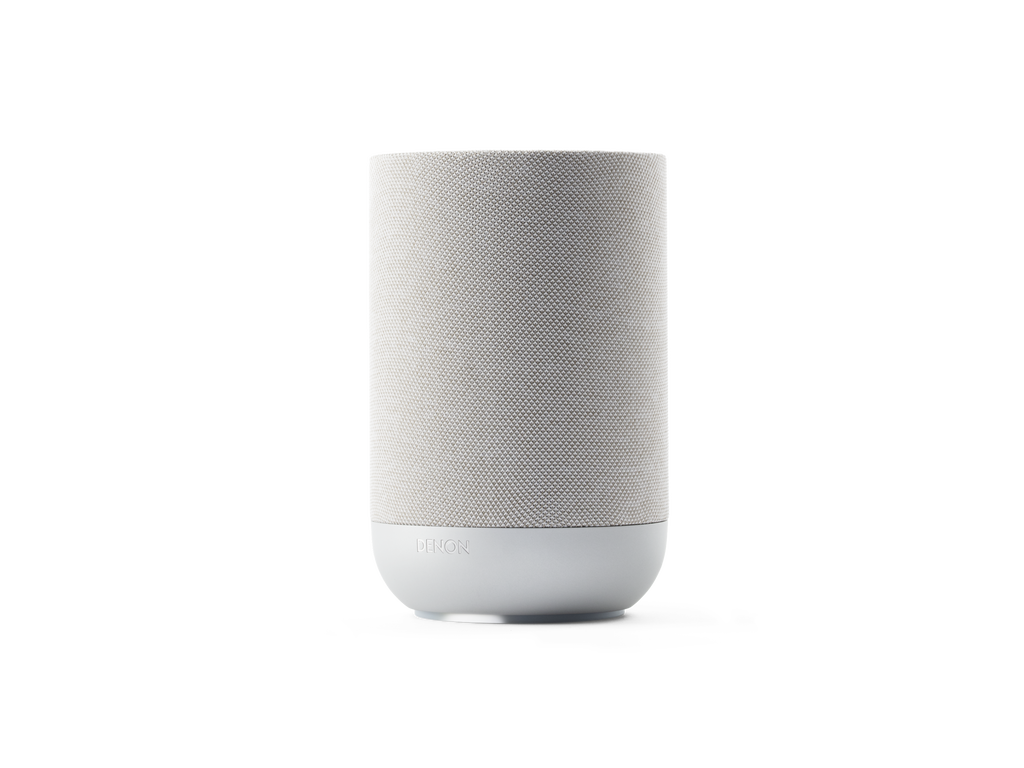
Denon Home 200

- Speaker format
- Standalone stereo
- Amplifiers / drivers
- 3 / 3
- Driver layout
- 2 × 25 mm tweeters; 1 × 102 mm woofer
- Dolby Atmos
- Virtual height processing
- Sound and room
- Clear, focused and compact; roughly up to 15 m²
- Cabinet size (H × W × D)
- 216 × 140 × 140 mm
- Weight
- 2.2 kg
- Wireless network
- Tri-band Wi-Fi: 2.4, 5 and 6 GHz; Bluetooth; AirPlay 2
- Physical connections
- 3.5 mm analogue input; USB-C for storage or Ethernet adaptor
- Home cinema role
- Wireless surround for Home Sound Bar 550; the practical rear-speaker choice
- Finishes
- Charcoal or Stone
Lounge · Physical Atmos
Denon Home 400

- Speaker format
- Standalone stereo
- Amplifiers / drivers
- 6 / 6
- Driver layout
- 2 × 19 mm tweeters; 2 × 114 mm woofers; 2 × 25 mm up-firing drivers
- Dolby Atmos
- 2 physical up-firing height drivers
- Sound and room
- Fuller and more open; roughly 15 to 30 m²
- Cabinet size (H × W × D)
- 219 × 300 × 150 mm
- Weight
- 4.2 kg
- Wireless network
- Tri-band Wi-Fi: 2.4, 5 and 6 GHz; Bluetooth; AirPlay 2
- Physical connections
- 3.5 mm analogue input; USB-C for storage or Ethernet adaptor
- Home cinema role
- Wireless surround for Home Sound Bar 550
- Finishes
- Charcoal or Stone
Large room · Physical Atmos
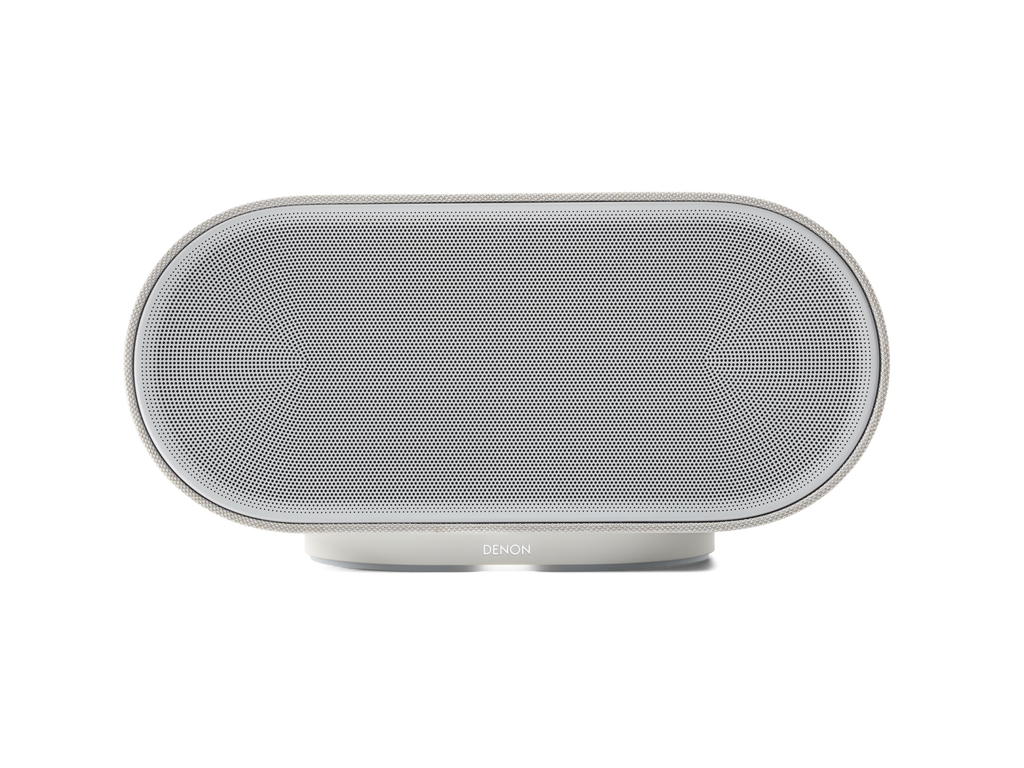
Denon Home 600
- Speaker format
- Standalone stereo
- Amplifiers / drivers
- 8 / 8
- Driver layout
- 2 × 19 mm tweeters; 2 × 66 mm midrange; 2 × 66 mm up-firing drivers; 2 × 165 mm woofers
- Dolby Atmos
- 2 physical up-firing height drivers
- Sound and room
- Deepest bass and greatest headroom; roughly 30 m² and above
- Cabinet size (H × W × D)
- 226 × 451 × 251 mm
- Weight
- 8 kg
- Wireless network
- Tri-band Wi-Fi: 2.4, 5 and 6 GHz; Bluetooth; AirPlay 2
- Physical connections
- 3.5 mm analogue input; USB-C for storage or Ethernet adaptor
- Home cinema role
- Wireless surround for Home Sound Bar 550
- Finishes
- Charcoal or Stone
*These room sizes are practical starting points, not Denon specifications. Ceiling height, open doorways, furnishings and listening distance all count. A sparsely furnished 20 m² open-plan room can be tougher to fill than a closed 30 m² lounge. Square metres never tell the whole story. They just look reassuring on a spec sheet.
What Denon changed for 2026
Denon has put the same basic platform under all three speakers. Each model plays stereo on its own, supports Dolby Atmos Music and connects to the wider HEOS system. Stone and Charcoal finishes keep the range visually consistent, so a Home 200 in the bedroom does not look unrelated to a Home 600 downstairs.
The connections are the same across the range: tri-band Wi-Fi on 2.4, 5 and 6 GHz, Bluetooth, AirPlay 2, a 3.5 mm analogue input and USB-C. That USB-C port can read compatible music storage or take a USB-C to Ethernet adaptor. HEOS also gives you bass, treble and placement adjustment. There are three Quick Select buttons on top, and every model works with the Denon Home Subwoofer.
Voice control needs a footnote because the words "Siri ready" do a lot of work. These are not standalone Alexa or Google Assistant speakers. Siri control requires an Apple Home setup and a HomePod on the same network. If voice control matters, budget for the Apple hardware too. Fine print remains undefeated.
Home 200: small room, serious upgrade
The Home 200 is the smallest model, but Denon has stopped treating compact as another word for mono. Two 25 mm tweeters carry the left and right information, while one 102 mm woofer handles bass. Each driver has its own Class-D amplifier.
The result favours clean vocals and useful spread over chest-thumping bass. Engadget found the 200 balanced and clear for its size, although its lower frequencies and midrange sounded more compressed than the 400. That tracks with the hardware. One 102 mm woofer can only move so much air before physics sends the invoice.
In a kitchen, bedroom or home office, that balance makes sense. The Home 200 stays articulate at sensible listening levels and does not swamp the room. Buy a second one and HEOS can turn the pair into proper left and right speakers. The threaded mount underneath also makes wall or stand placement straightforward, which matters when the same pair moves behind a sofa as surrounds.
Home 200 versus Home 150
The Home 200 replaces the closest thing Denon had to a compact entry model, but this is more than a new number on the box. The Home 150 is a mono speaker with one tweeter and an 89 mm woofer. The Home 200 adds a second tweeter for standalone stereo, increases the woofer to 102 mm and brings virtual Dolby Atmos Music. It is bigger and 500 g heavier, but still compact enough for a bedside table or wall bracket.
There are trade-offs. The Home 150 has a built-in Ethernet socket and native Alexa. The Home 200 needs an optional USB-C Ethernet adaptor and switches to Siri-ready control. Existing Home 150s still work in a mixed HEOS multi-room system, but do not combine a 150 and 200 as a permanent stereo pair. Stereo pairs work properly when both speakers match. Audio has enough variables already.
Home 400: the lounge-sized one
The Home 400 is where Denon adds real height hardware. Its six-driver layout has two tweeters, two 114 mm woofers and two 25 mm drivers aimed at the ceiling. Every driver gets its own amplifier. With a compatible Atmos Music track, the up-firing pair reflects sound from the ceiling to add a height layer above the main stereo image.
This is the sensible single-speaker choice for most living rooms. Reviews from Engadget and TechRadar describe clear vocals, solid bass and better separation than the 200 once a track becomes crowded. More volume is part of the benefit, but control is the bigger gain. The 400 does not bunch every instrument together when the chorus arrives.
It also avoids the furniture problem created by the 600. At 300 mm wide, the 400 still needs a proper surface, yet it fits where a 451 mm speaker may not. HEOS provides width and height controls for Atmos playback, and a second Home 400 can form a stereo pair. Two of them need 600 mm of cabinet width before you leave any breathing room, so measure first. Furniture has never respected an online product photo.
Home 600: built for rooms with acreage
The Home 600 uses eight amplified drivers. Two 19 mm tweeters handle the top end, two 66 mm drivers cover the midrange, and two more 66 mm drivers fire upwards for Atmos. Bass comes from a pair of opposing 165 mm woofers that Denon calls built-in subwoofers.
That division matters. The midrange drivers can deal with vocals and instruments while the large woofers do the heavy lifting below. Tom's Guide and Engadget both found the 600 clean and substantial, with strong bass that did not smother the rest of the mix. It also keeps more detail at low volume and has the headroom to play loudly without sounding flustered.
The cabinet is 451 mm wide, 251 mm deep and weighs 8 kg. It needs a deep shelf, media unit or stand rated for the job. In a compact room, you will spend more money and sacrifice more space to use a fraction of what it can do. Put it in a large lounge or open-plan entertainment area and the design starts to make sense. The Home 600 is less a shelf speaker than a polite piece of furniture with two subwoofers inside it.
Dolby Atmos without the hand-waving
"Supports Dolby Atmos" can describe two very different jobs in this range. One is playing Atmos Music from a single speaker. The other is taking part in a TV surround system. Mixing them together makes the feature sound more magical than it is.
Atmos Music from one speaker
The Home 200 has no up-firing driver. It uses digital processing to create a virtual sense of width and height from its three-driver layout. The sound can reach beyond the cabinet, but there is no physical height channel bouncing from the ceiling.
The Home 400 and Home 600 do have dedicated up-firing drivers. They send part of an Atmos mix towards the ceiling, which reflects it back to the listening area. Ceiling height, shape and material affect the result. A flat ceiling is helpful. A steeply pitched, double-volume Cape Town ceiling will not read Denon's brochure and cooperate.
Denon currently lists three routes for native Dolby Atmos Music: TIDAL Connect, TIDAL inside HEOS and Amazon Music Unlimited inside HEOS. You need the right subscription. Check for the Atmos badge on the HEOS Now Playing screen. Bluetooth or AirPlay does not become Atmos simply because the receiving speaker has the logo.
Home 200s as rear surrounds
Pair two Home 200s with a Denon Home Sound Bar 550 and HEOS can assign them as wireless left and right surrounds. The soundbar receives the TV signal over HDMI ARC or eARC, decodes Dolby Atmos and handles the front soundstage. It then sends the correct rear-channel information to each speaker behind the sofa.
Real speakers behind you make the Atmos presentation more convincing because rear effects come from the rear. Radical, we know. The Home 200s do not turn into ceiling speakers or up-firing height channels. They handle the surround layer. The Sound Bar 550 remains responsible for decoding Atmos and creating its virtual height effect.
Denon allows all three new Home models to act as surrounds for the Sound Bar 550. The Home 200 is usually the right tool for the job. It is easier to mount, easier to hide and has ample output for effects and ambience. A pair of Home 600s behind the couch would work, but so would using a bakkie for the school run.
Denon has also announced wireless surround support for the 2026 AVR-S980H, AVR-X2900H and AVR-X3900H. The launch material says this will arrive through a firmware update. Denon's public manuals and changelog had not confirmed a general release when we checked on 12 August 2026. Confirm the receiver model, regional support and installed firmware before planning a system around it. Announced is not the same as installed.
HEOS: one app, three different jobs

HEOS connects Denon Home speakers with compatible Denon and Marantz receivers, soundbars, amplifiers and music systems. Every product appears as a named room. You can choose a source, change the volume and EQ, or play different music in separate rooms. Group several rooms and HEOS keeps one source in sync while you move through the house.
Multi-room grouping, stereo pairing and surround assignment are not interchangeable:
- A multi-room group plays the same programme in sync across different rooms.
- A stereo pair combines two matching speakers as permanent left and right channels in one room.
- A surround pair assigns speakers to separate movie channels behind the listener. Dragging two rooms together only groups them. It does not create surround sound.
The distinction sounds obvious until an app gives everything a room name and lets you drag it around. Then perfectly sensible people start expecting the kitchen to become a rear channel.
How to add a Denon Home speaker
- Put the speaker within reliable Wi-Fi range and connect it to power.
- Connect your phone to the same home network and enable Bluetooth for setup.
- Open HEOS. Choose Setup Now for the first product or Settings > Add Device for another one.
- Follow the prompts, name the room and let any firmware update finish.
- Add your music services, then adjust placement, bass and treble for that room.
How to group several rooms
- Start music in one room.
- Open the Rooms tab.
- Press and hold another room, drag it onto the room already playing and release.
- Use the group volume for the whole system or open the group to trim each room.
- Drag a room back out when you want it to play independently.
Save a Group Preset for combinations you use often, such as Kitchen + Dining + Patio. One tap beats rebuilding the group every Saturday.
How to make a stereo pair
- Add two matching Home 200s, two Home 400s or two Home 600s to HEOS.
- In Rooms, group only those two speakers.
- Tap the three-dot menu, choose Edit Rooms and open the group.
- Turn on Stereo Pair, confirm left and right, then save.
The pair now appears as one room and receives proper left and right audio instead of duplicated mono.
How to add Home 200 surrounds to the Sound Bar 550
- Update the soundbar, both speakers and the HEOS app. Connect all three products to the same network.
- Open Home > Settings > My Devices and select the Denon Home Sound Bar 550.
- Choose Setup Assistant > Surrounds.
- Select the two Home 200s and assign left and right when prompted.
- If you have a Denon Home Subwoofer, return to Setup Assistant > Subwoofer and choose the setting optimised for the Sound Bar 550.
- Play a film you know and trim the surround level for the main seating position.
Match the room, not the model number
Use the Home 200 where space is tight, listening distances are short or you need discreet rear surrounds. It is also the least intrusive way to add HEOS to a bedroom, kitchen or office.
Use the Home 400 when one speaker has to carry everyday music in a normal lounge. It adds physical Atmos height and has more bass reserve than the 200, without demanding the shelf space of the 600.
Use the Home 600 in a large lounge, a long listening space or an open-plan area that swallows smaller speakers. Its dedicated midrange and two 165 mm woofers give it the scale to be the main music system rather than expensive background noise.
A good HEOS system may use all three models. Put the 600 where the room needs muscle, the 400 where one cabinet must cover a lounge, and the 200s in smaller rooms or behind the sofa. Matching every room with the same speaker would look tidy on an invoice. It would make far less sense in the house.
Questions worth asking before checkout
Can the old Home 150 work with the new range?
Yes. The Home 150 can join the Home 200, 400 and 600 in a HEOS multi-room group. Denon also keeps the new range compatible with other HEOS Built-in products. Use matching models for a permanent stereo pair, so do not pair a Home 150 with a Home 200 as left and right speakers.
Do two Home 200s create a complete Atmos cinema system?
No. A pair can play Dolby Atmos Music using the Home 200's virtual processing, but it cannot decode TV sound and replace a complete cinema system. For TV surround, add the pair to a compatible Home Sound Bar 550. Selected 2026 Denon AV receivers will also support wireless surrounds once the required firmware is available.
Do Home 400 or 600 surrounds add rear height channels?
Denon confirms that both models can act as wireless surrounds for the Sound Bar 550. Its public setup documents do not confirm that their up-firing drivers become separate rear height channels in that arrangement. Do not specify them as rear heights unless Denon confirms the channel mapping for the exact soundbar or receiver firmware.
Can HEOS send a turntable to other rooms?
Yes. Connect a line-level source to a Denon Home speaker's 3.5 mm input and HEOS can distribute it to grouped rooms. A turntable still needs a suitable phono stage unless one is built in. Vinyl may be analogue. The multi-room trip is not.
Build it around the house
The Home 200 covers compact rooms and rear surround duty. The Home 400 has the right balance of size and output for most lounges. The Home 600 brings enough bass and headroom for a large, open space. HEOS lets those different speakers work together without pretending every room has the same needs.
For help sizing the speakers, checking the network and planning the surround layout, talk to Smart Spaces or browse our wireless audio collection. Bring the floor plan. We will leave the adjectives at the shop.
Sources
- HARMAN/Denon announcement: Denon Home 200, 400 and 600
- Denon Home 200 official product page
- Denon Home 400 official product page
- Denon Home 600 official product page
- Denon Home 150 official product page
- Denon support: Dolby Atmos Music playback routes
- Denon support: Siri requirements for Denon Home
- Denon support: grouping Denon Home speakers
- Denon manual: stereo pairing
- Denon manual: adding wireless surrounds to the Home Sound Bar 550
- HARMAN/Denon announcement: AVR-S980H wireless surround status
- What Hi-Fi?: AVR-X2900H and AVR-X3900H wireless surround announcement
- Engadget: Denon Home 200, 400 and 600 listening comparison
- TechRadar: Denon Home 400 review
- Tom's Guide: Denon Home 600 review
Research and product status checked on Aug 2026. Streaming services, voice support and announced firmware features vary by region and may change after publication.